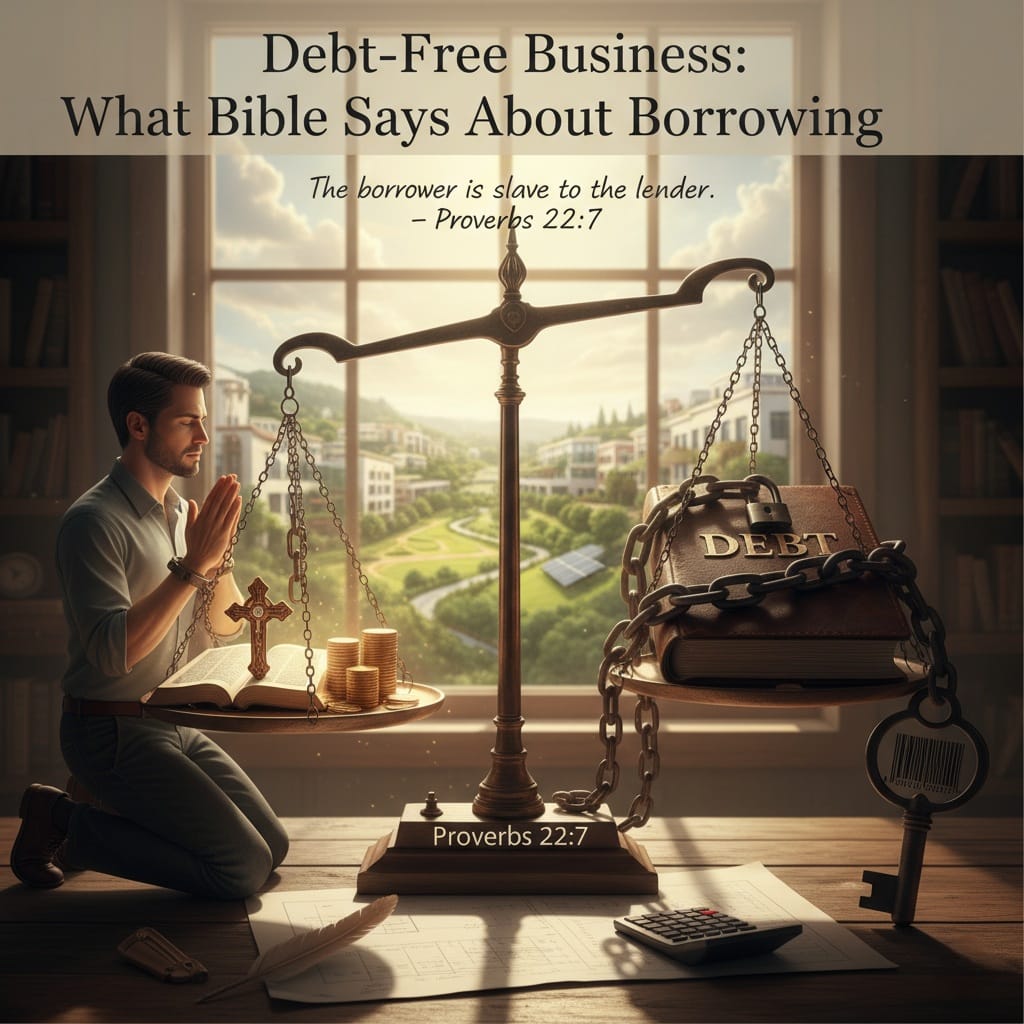

“The rich rule over the poor, and the borrower is slave to the lender.” – Proverbs 22:7
As a Christian entrepreneur, you’ve likely wrestled with one of business’s most pressing questions: Should I borrow money to grow my business? The pressure to scale quickly, invest in equipment, or expand your team can make debt seem like the only viable path forward. But what does God’s Word say about borrowing, and is it possible to build a thriving business without it?
The answer isn’t as simple as “never borrow” or “always avoid debt.” Instead, Scripture offers profound wisdom about the nature of debt, the dangers of becoming enslaved to lenders, and the freedom that comes from financial stewardship rooted in faith.
What the Bible Really Says About Debt
Debt Creates Bondage
Proverbs 22:7 doesn’t mince words: “The borrower is slave to the lender.” This isn’t just poetic language—it’s a spiritual and practical truth. When you owe money, you surrender a degree of freedom. Your decisions become constrained by payment schedules, interest rates, and the lender’s terms.
In ancient Israel, debt could literally lead to servitude (2 Kings 4:1). While modern bankruptcy laws protect us from physical slavery, the principle remains: debt binds us to obligations that limit our ability to respond to God’s leading.
Debt Presumes on the Future
James 4:13-15 warns against presuming we know what tomorrow holds: “Now listen, you who say, ‘Today or tomorrow we will go to this or that city, spend a year there, carry on business and make money.’ Why, you do not even know what will happen tomorrow… Instead, you ought to say, ‘If it is the Lord’s will, we will live and do this or that.'”
When you borrow, you’re making a promise based on future income you haven’t earned yet. You’re betting that your business will generate enough revenue to repay the loan—but only God knows what tomorrow brings. Economic downturns, health crises, or unexpected competition can derail even the best-laid plans.
Debt Can Reflect a Lack of Trust
Sometimes, taking on debt reveals a deeper issue: we’re trusting in our own ability to generate wealth rather than trusting God to provide. Philippians 4:19 promises, “And my God will meet all your needs according to the riches of his glory in Christ Jesus.”
This doesn’t mean God will hand you a business loan—but it does mean He’s capable of providing the resources you need through creative, unexpected means. Before you borrow, ask yourself: Am I taking this loan because I’m impatient with God’s timing? Or because I genuinely believe this is wise stewardship?
When Borrowing Might Be Wise Stewardship
While Scripture warns against debt, it doesn’t outright forbid it. The Bible acknowledges that borrowing exists and even provides guidelines for lending (Exodus 22:25, Deuteronomy 15:7-8). So when might debt be acceptable for a Christian entrepreneur?
1. When It’s for Productive Assets, Not Consumption
There’s a difference between borrowing to buy inventory that will generate revenue and borrowing to fund a lifestyle you can’t afford. Proverbs 21:5 says, “The plans of the diligent lead to profit as surely as haste leads to poverty.”
If a loan will help you acquire equipment, hire staff, or expand capacity in ways that directly increase revenue, it may be wise stewardship. But if you’re borrowing to cover operating expenses or personal spending, that’s a red flag.
2. When You Have a Clear Repayment Plan
Psalm 37:21 says, “The wicked borrow and do not repay, but the righteous give generously.” Before taking on debt, you must have a realistic, God-honoring plan to repay it. This means:
- Conservative revenue projections (don’t assume best-case scenarios)
- A margin of safety (can you still repay if revenue drops 20%?)
- An exit strategy (what happens if the business fails?)
3. When You’ve Prayed and Sought Godly Counsel
Proverbs 15:22 reminds us, “Plans fail for lack of counsel, but with many advisers they succeed.” Before borrowing, seek wisdom from:
- Mature believers who understand both business and biblical stewardship
- Financial advisors who can assess the risk objectively
- Your spouse (if married), ensuring you’re in agreement
- God Himself, through prayer and Scripture
If you sense unease in your spirit, don’t ignore it. The Holy Spirit often speaks through that “check” in your heart.
The Case for Building Debt-Free
While strategic borrowing can sometimes be justified, there’s immense freedom in building a business without debt. Here’s why:
1. You Maintain Full Control
When you’re debt-free, you answer only to God—not to banks, investors, or creditors. You can pivot your business model, take a sabbatical, or give generously without needing permission from lenders.
2. You Sleep Better at Night
Proverbs 3:24 says, “When you lie down, you will not be afraid; when you lie down, your sleep will be sweet.” Debt brings stress. Freedom from debt brings peace.
3. You Model Faith to Others
When you build slowly, trusting God’s provision rather than leveraging debt, you demonstrate radical faith. Your business becomes a testimony to God’s faithfulness.
4. You Avoid the Trap of Overexpansion
Many businesses fail not because they lacked potential, but because they grew too fast on borrowed money. Proverbs 13:11 says, “Dishonest money dwindles away, but whoever gathers money little by little makes it grow.”
Practical Steps to Build (or Become) a Debt-Free Business
Start Small and Bootstrap
- Begin with what you have, not what you wish you had (2 Corinthians 8:12)
- Reinvest profits rather than taking on debt
- Grow organically, even if it’s slower
Cut Unnecessary Expenses
- Distinguish between needs and wants
- Operate lean—fancy offices and equipment can wait
- Practice contentment (1 Timothy 6:6)
Increase Revenue Before Increasing Costs
- Don’t hire until you have consistent income to support it
- Test new products/services before investing heavily
- Focus on profitability, not just growth
Create an Emergency Fund
- Save 3-6 months of operating expenses
- This buffer prevents you from needing debt during slow seasons
- Proverbs 21:20: “The wise store up choice food and olive oil, but fools gulp theirs down.”
If You’re Already in Debt, Make a Plan
- Commit to paying it off as quickly as possible
- Avoid taking on new debt while repaying old debt
- Pray for wisdom and discipline (James 1:5)
Trusting God as Your Provider
Ultimately, the question isn’t just “Should I borrow?” but “Who am I trusting?”
Matthew 6:33 promises, “But seek first his kingdom and his righteousness, and all these things will be given to you as well.”
God is not opposed to your business success—He’s opposed to anything that replaces Him as your source. Whether you choose to borrow or build debt-free, the key is to:
- Pray continually about financial decisions
- Seek godly counsel before making commitments
- Trust God’s timing, even when it’s slower than you’d like
- Honor your commitments if you do borrow
- Give generously, recognizing that everything belongs to God
Final Thoughts: Freedom Over Speed
In a culture obsessed with rapid growth and leveraging debt, choosing to build slowly and debt-free is counter-cultural. But it’s also deeply biblical.
Proverbs 22:7 isn’t just a warning—it’s an invitation to freedom. Freedom to obey God without financial constraints. Freedom to be generous without guilt. Freedom to rest without anxiety.
Your business may grow slower without debt. You may miss some opportunities. But you’ll also experience something priceless: the peace that comes from knowing you’re fully dependent on God, not on lenders.
So ask yourself: Am I building a business that honors God, or am I building a business that enslaves me?
The choice is yours. Choose freedom. Choose faith. Choose to trust the God who owns the cattle on a thousand hills (Psalm 50:10) and promises to provide for His children.
Prayer for Financial Wisdom:
“Lord, give me wisdom to steward the resources You’ve entrusted to me. Help me discern when to wait on Your provision and when to move forward in faith. Protect me from the bondage of debt and the pride of self-sufficiency. May my business reflect Your kingdom values—not the world’s obsession with speed and leverage. I trust You as my Provider. In Jesus’ name, Amen.”
What’s your biggest financial challenge as a Christian entrepreneur? Share in the comments below.